Holding the Zones Note 1 of 7
When a Sub-Zero Wine Cooler Will Not Hold Its Zones
- Written by
- Bjorn Aaltonen
- Bench
- wine storage and dual zones
- Years in the trade
- 15
- Refrigerant
- EPA 608 certified
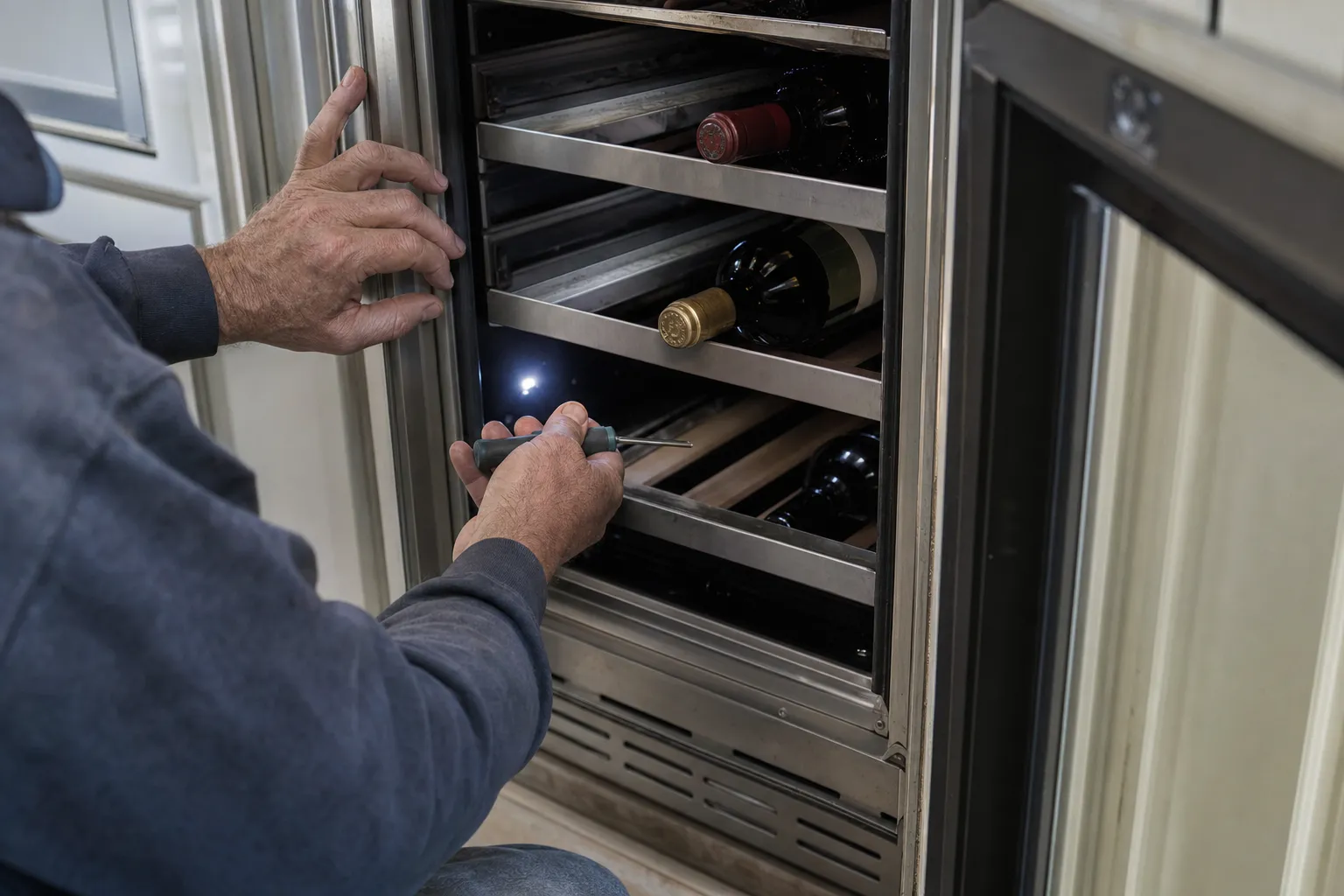
Wine storage fails quietly. A refrigerator that stops cooling announces itself within a day, because the food goes off. A wine cooler that has drifted three degrees warm will sit there for months looking perfectly normal, and the first sign is often a bottle that tastes tired rather than a display that reads wrong.
Island kitchens that were remodeled around undercounter or full-height wine storage now have units that have spent years breathing lake-damp air, and that is when the first real faults turn up. Most of them sit in parts that can be replaced on their own, and the compressor comes at the end of the list, not the start.
What a dual-zone unit is actually doing
A dual-zone cabinet is not one cold box with a partition in it. Sub-Zero describes its wine storage as having dual evaporators, one for each storage zone, so each compartment has its own coil, its own air moving across that coil, and a thermistor reporting that zone’s temperature back to the control board.
That architecture matters for diagnosis, because a single failed component produces very different symptoms depending on which zone it belongs to. A failed zone thermistor makes the board chase a temperature that is not real. A zone whose coil has iced over, or whose air has stopped moving, warms while its neighbor carries on as if nothing had happened.
So “both zones are warm” and “one zone is warm” are genuinely different faults, and the first question we ask on the phone is which of the two you have.
Both zones warm, compressor running constantly
When the whole cabinet has drifted up and the unit is running more or less continuously, the problem is nearly always heat rejection rather than cooling capacity.
The condenser on an undercounter unit lives behind the lower grille, inches off the floor, in the part of the kitchen that collects dust, pet hair and whatever the vacuum pushes under the cabinets. Once it is blanketed, the system cannot dump heat, head pressure climbs, and the cabinet cannot get down to set point no matter how long the compressor runs. A clean condenser is the first thing Sub-Zero’s own troubleshooting asks owners to confirm when a unit runs warm and long, and it is a maintenance item, not a failure.
The second suspect is airflow around the unit rather than through it. Panel-ready installations sometimes get sealed in more tightly than the specification allows during a remodel — a toe-kick that blocks the intake, or a surround with no clearance at the top. The unit worked for years because the kitchen was cool, and then one warm summer it stopped keeping up.
Only after both of those have been ruled out does a sealed system fault become a realistic answer, and that requires gauges rather than guesswork.
One zone warm, the other one fine
A split between the compartments points at that zone’s own air, sensor or coil rather than at the machine as a whole.
The usual causes, in the order we find them:
- An iced or starved zone evaporator. Frost that never fully clears from one zone’s coil, or air that has stopped moving across it, lets that compartment climb slowly toward the temperature of the room.
- A failed zone thermistor. The board is reading a temperature that does not match reality and is regulating perfectly against bad information. These often fail gradually, which is why the drift is slow rather than sudden.
- A weak or seized circulation fan. Air is not being moved from that zone’s coil across its bottles. Often audible if you know what to listen for — a change in the running note rather than an obvious noise.
- Shelf loading. Genuinely worth checking. A cabinet packed solid to the back wall blocks the air path, and the bottles furthest from the coil are the ones that suffer. Pull the load forward an inch and see whether it recovers over forty-eight hours.
None of those are expensive parts. All of them are diagnosable in a single visit if the readings are taken properly rather than assumed from the display.
Condensation, lighting and the noise complaints
Three secondary symptoms come up often enough to be worth naming.
Moisture inside the glass is warm humid air getting in. That is a door gasket that has gone hard, or a door that has dropped on its hinge and is no longer pulling square. On an island kitchen in August it will be dramatic; the underlying fault is the same in February, and the Lake Air notes follow that moisture from the glass to the coil.
Lighting that flickers or stays on is a switch or a driver, not a cooling fault — but it is worth reporting, because interior lighting left running adds heat to the cabinet continuously and can be the reason a marginal zone finally went out of range.
A louder hum than it used to make is usually a fan bearing or a compressor mount rather than the compressor itself. Sub-Zero wine units are quiet machines, and owners notice the change long before anything reads wrong. It is a good early warning and worth acting on while it is still just a noise.
What to do before you call
Take readings rather than trusting the display. A cheap probe thermometer left in a glass of water on the middle shelf of each zone overnight will tell you what the wine is actually experiencing, which is the number that matters. Note both, note the set points, and note whether the unit is running constantly or cycling.
Then check three physical things: the condenser behind the lower grille, the door seal along its full length, and whether anything is packed hard against the rear wall. Each of them can be checked from the kitchen, and each can make a sound unit look faulty.
If the readings are steady and only slightly off, it is a calibration and control conversation. If one zone has walked away from the other, it is a sensor, a fan or that zone’s coil, and it is wine storage repair rather than anything you can settle from the kitchen. If the whole cabinet is warm and the compressor never rests, start with the condenser — and if it is clean, that is when the gauges come out.
Asked about this
How far apart should two zones actually run?
That is your choice rather than the machine's; many owners keep reds in the mid fifties and whites in the mid forties. Every zone moves around its setting as the door opens and the room changes. A zone that stays well away from its number after a quiet day is worth a call to (206) 208-3377.
Does condensation on the glass mean the seal has failed?
Not always. Moisture on the outside of the glass is usually room humidity meeting a cold pane and is normal in a warm kitchen. Moisture on the inside of the glass, or beads forming on the top shelf bottles, points at warm air being drawn in — a door gasket, a misaligned door, or a hinge that has dropped.
Is it worth repairing an older wine unit?
Often it is. Gaskets, fans, thermistors, lights and control boards can each be replaced on their own, so an older cabinet is not written off for one of them. The harder cases involve the sealed system, and those are priced after the diagnosis so you can weigh the repair against the age of the unit.