Lake Air Note 8 of 8
Why Is the Bottom of My Sub-Zero Fridge Wet?
- Written by
- Bjorn Aaltonen
- Bench
- wine storage and dual zones
- Years in the trade
- 15
- Refrigerant
- EPA 608 certified
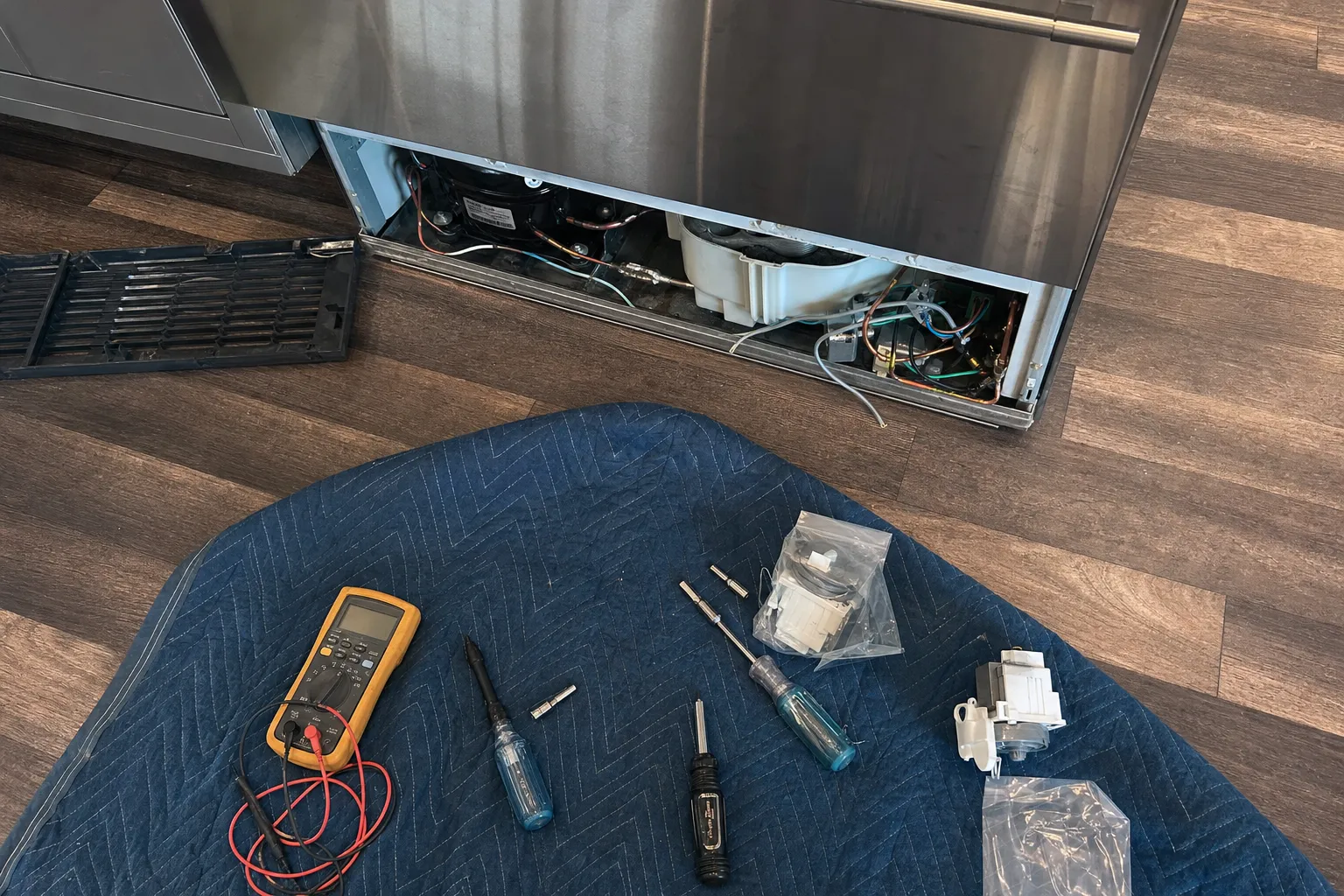
Water at the bottom of a fridge nearly always comes from the defrost system. On a regular cycle the cooling coil sheds its frost as water, which is meant to trickle down a drain tube into a shallow pan, usually low in the unit, where warmth from the refrigeration system dries it off. If that drain clogs or freezes, the water backs up and collects under the crisper drawers. If the pan overflows or the tube slips loose, it reaches the floor instead. On a model with an ice maker, the water line is the third suspect. Working out which of the three you have decides whether a towel, a kitchen baster or a technician solves it.
Why a cold cabinet makes water at all
Room air always carries some moisture. Each time a door opens, that air rolls in, and when it meets the coldest surface in the cabinet, the evaporator coil, the moisture drops out as frost. In a Sub-Zero with Dual Refrigeration, the refrigerator section is cooled by a system of its own rather than by air borrowed from the freezer. The Classic Series guide spells out the payoff: the fresh-food air is never dried out by a below-freezing coil, and fresh-food smells stay away from the frozen food and the ice. The trade-off is a damper refrigerator compartment, so a working drain matters more. On an island in Lake Washington, through a long, wet Northwest autumn and spring, kitchen air is rarely bone-dry, and each opening of the door lets some of it in.
Where melted frost is supposed to go
Frost on a coil acts like insulation, so the system clears it on a schedule. In the freezer a heater warms the coil for a short spell; on many fresh-food coils the frost simply melts while the compressor rests. Either way, the meltwater drips into a trough under the coil, finds a hole at its lowest point and falls through a tube toward the pan. Nothing pumps it along. Gravity does the whole job, so a crumb, a scrap of label or a plug of ice is enough to stop it. On certain older combination models the model number even hints at how many coils need draining: the count of 1s matches the number of compressors, so a 361RFD runs one system while a 3211RFD runs two, each shedding its own meltwater.
Water pooled inside, under the crisper drawers
A puddle under the crispers, or a film of water sliding down the back wall, means the drain is blocked somewhere between the trough and the pan. Debris washed into the opening is one cause; ice is the other. Meltwater refreezes before it clears the drain when a door has been left ajar long enough to load the coil with frost, or when a defrost heater, thermostat or sensor has begun to fail and the coil only half-melts each time. A telltale sign of that second case is a flat sheet of ice across the freezer floor, or frost creeping out from behind the rear panel. If the drain opening is within reach, a baster of warm water can shift a light clog. When the water just sits there, the blockage is lower down or frozen solid.
Water on the floor at the toe-kick
Water outside the cabinet started below. The pan is sized to evaporate ordinary defrost water, not a flood, so a heavily frosted coil melting all at once can overfill it. A cracked pan, or a drain tube that has slid off its outlet, sends water straight onto the subfloor, where it creeps forward and shows up at the toe-kick. Sub-Zero’s comparison shows the machinery moving between lines: Classic models carry a flip-up grille at the top, Designer units theirs at the bottom. Either way, a built-in is anchored into its cabinetry and very heavy, so sliding it out to reach the pan is work for a technician. Beads of moisture on the outside panels usually mean a seal that no longer closes tight; our note on drawers that no longer pull themselves shut covers that.
The ice maker and its water line
If the unit makes ice, water under pressure is part of the picture too. Sub-Zero says its in-unit ice makers harvest about 8 cubes (4.6 oz) every 2-3 hours, between 64-96 cubes a day, and stop once the bin is full. Each harvest begins with a short fill through a valve and a small tube. A valve that seeps leaves water in small amounts on roughly that rhythm, and a fill tube that has frozen makes the next fill spill over and run down inside the freezer. The supply line behind or beside the cabinet is the other suspect, especially after any recent kitchen work. Switching the ice maker off for a day makes a good test: if the floor stays dry, the water side is where the trouble lives.
What the repair usually involves
Most bottom-of-the-fridge water comes down to a cleared drain, a refitted tube or pan, a new defrost heater, thermostat or sensor, a fresh door seal, or a replacement water valve. None of those touches the sealed system. When frost patterns do point toward the refrigerant side, Sub-Zero’s current guides are firm that only technicians trained on flammable refrigerant may work on it. Mercer Island Sub-Zero Service looks after homes from Town Center and First Hill to Mercerwood and East Seattle; ring (206) 208-3377 or read how a visit runs on our refrigerator repair page. Our $89 call-out pays for the trip to your door and a complete diagnosis, and if you approve the work we deduct it from the repair invoice. Each fix has its own typical range; the firm number comes once the cause is confirmed.
Before you call
-
Step 1
Find where the water sits
Under the crispers points to the drain, the freezer floor to refrozen meltwater, the toe-kick to the pan or its tube, and the cabinet beside the unit to the water line.
-
Step 2
Watch every door and drawer seal
Close each one slowly and look for a gap along the gasket. A seal that lifts lets damp air in and loads the coil with frost.
-
Step 3
Look for ice where it should not be
A sheet of ice on the freezer floor, or frost spreading out from the rear panel, suggests a frozen drain or a defrost part that is failing.
-
Step 4
Give the ice maker a day off
Switch it off for twenty-four hours. If the floor stays dry, the fill valve, the fill tube or the supply line is the likely source.
-
Step 5
Write down the serial number
Over-and-under Classic (BI, CL) units show the tag just inside the refrigerator door by the upper hinge. On a side-by-side, open the freezer door; on a Classic French-door, the left door.
-
Step 6
Towel the base and close the valve
Lay towels along the toe-kick, and if water runs steadily from the supply line, shut its valve until the leak is traced.
Past these checks the fault is inside the machine. Call Mercer Island Sub-Zero Service on (206) 208-3377 and say which step changed nothing.
Asked about this
Why is the bottom of my fridge wet in the morning?
Overnight water usually means a defrost cycle ran and its meltwater had nowhere to go. Defrost runs on the unit's own schedule, not yours, and with nobody opening doors the puddle sits undisturbed until breakfast. Water inside under the drawers points to the drain; water on the floor points to the pan, the drain tube or the ice maker line.
Why is my new fridge leaking water from the bottom?
In a newly installed refrigerator, look first at the water supply connection, a drain tube nudged loose in delivery, or a cabinet that is not level, which lets meltwater miss the drain opening. Press a dry paper towel against the supply fitting, then check the unit sits level side to side. If both pass, call (206) 208-3377 before the floor takes damage.
How can I reduce moisture inside my refrigerator?
Keep warm, damp air out and give the moisture inside a way to leave. Cover liquids and leftovers, let hot food cool before it goes in, close doors promptly, and keep the drain opening free of crumbs. A Sub-Zero with Dual Refrigeration keeps its fresh-food air moister on purpose, so a little dew on the back wall is normal; standing water is not.
Why is ice building up in my freezer?
Ice builds when more moist air gets in than the defrost system can clear, or when that system has stopped doing its job. A worn door seal or a drawer resting slightly open loads the coil quickly. A sheet of ice on the freezer floor is often drain water that refroze, pointing to a blocked drain or a failing defrost heater, thermostat or sensor.