Lake Air Note 2 of 7
Condensation on a Sub-Zero Wine Door: Reading Where the Water Forms
- Written by
- Bjorn Aaltonen
- Bench
- wine storage and dual zones
- Years in the trade
- 15
- Refrigerant
- EPA 608 certified
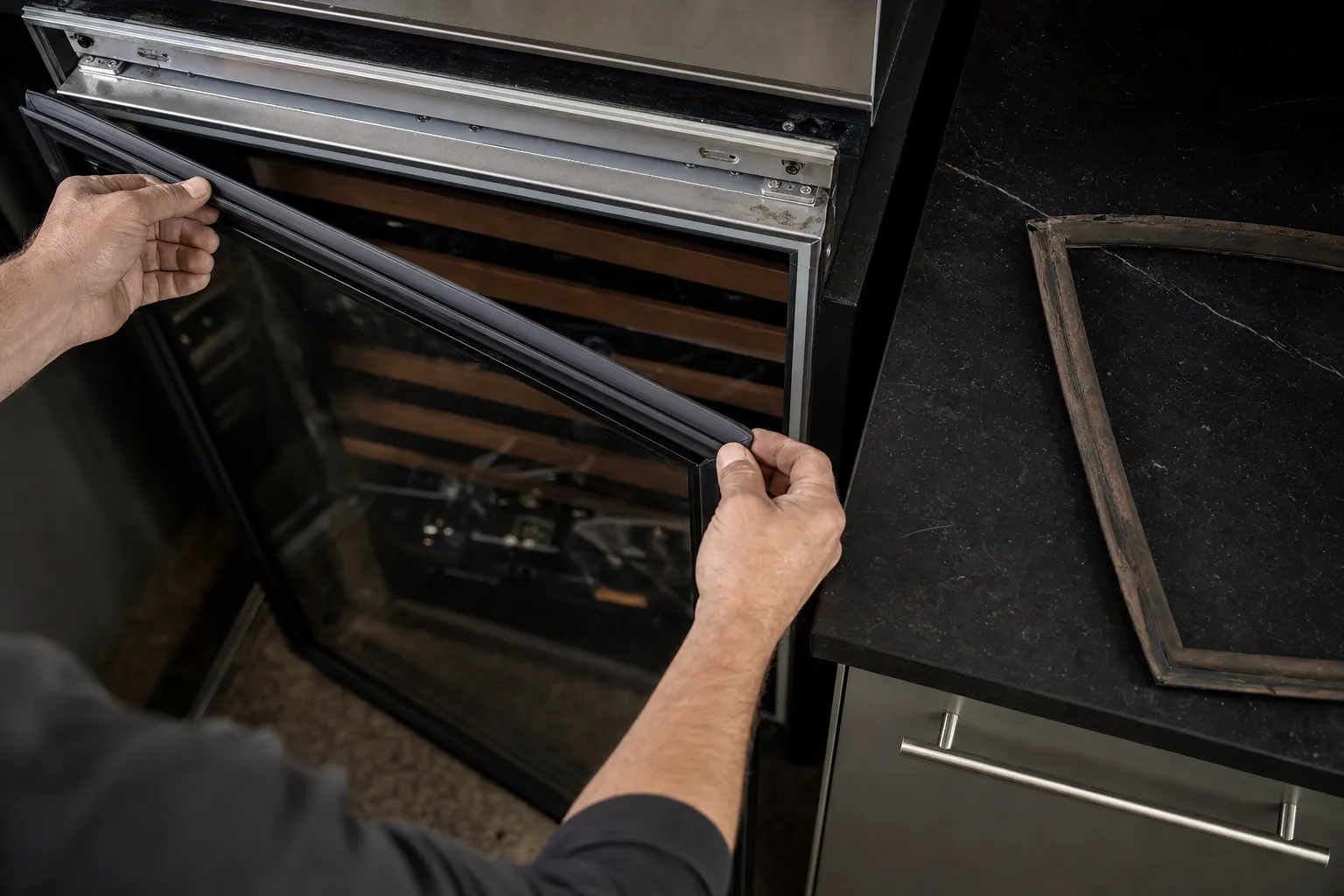
Before anything is taken apart, find out which side of the glass the water is on. On Mercer Island the air that reaches a wine cooler’s door has come off Lake Washington, and through the wet months each opening lets in moisture the cabinet then has to deal with. Where that moisture settles is the most useful clue an owner can give us.
A fogged door is not one fault. It is a symptom with at least four shapes, and they point in different directions: some at the kitchen, some at the door, one at the glass itself.
Four places the water shows up
On the room side of the glass. A mist you can wipe away with a cloth from the kitchen. The glass is cooled by the cabinet behind it, and damp kitchen air leaves water on anything colder than itself, the way a chilled bottle sweats on the table.
On the cabinet side. A haze or droplets that only the inside of the door can reach. That water came into the cabinet with room air, and the question becomes how it got in.
On the bottles and racks. Beads on the shoulders of the front bottles, damp wood facings, a wet rack front. It is the cabinet-side problem again, only further along.
Along the frame, or on the floor. Water on the cabinet face around the door opening usually means cold air spilling out past the seal and chilling the trim as it goes. Water collecting at floor level can be something else entirely: every refrigerated cabinet makes meltwater and has a route for getting rid of it, and that route can clog or overflow. It has its own page, on the condensate drain and pan.
One shape falls outside the four. A haze you cannot wipe from either side is not surface condensation at all. It sits in the glass, and it is a question about the door rather than the seal.
When mist on the outside is only the room
Outside mist that comes and goes with the weather is the kitchen, not the unit. It tends to appear on a wet evening, after a pot has been boiling nearby, or when a room full of people has warmed and dampened the air. It clears as the room dries, and nothing inside the cabinet changes.
Two patterns deserve a closer look. The first is a stripe that is always in the same place, along one edge or across the bottom of the door, while the rest of the glass stays clear. Cold air is heavier than warm air, so a gap low on the door lets it pour out and chill that edge from the outside. The second is outside mist that has become permanent in a room that is not especially damp. Both send us to the seal and to the way the door hangs.
When the water is inside the cabinet
Water on the inside of the glass means room air is getting in faster than the unit can dry it. According to Sub-Zero, the two evaporators in its wine units, a coil for each zone, hold the humidity at a steady, moderate level; they do it by drawing moisture out of the cabinet air onto their coils. Feed them a constant supply of lake air and they fall behind, and the surplus settles on the coldest surfaces it can find, the glass among them.
Some mist inside after a long restock with the door standing open is expected, and it should clear once the door has stayed shut for a while. When it keeps coming back, the usual routes are few:
- a door that no longer swings shut and seats on its own;
- a bottle neck or a rack front sitting far enough forward to hold the door off its seal;
- a door that has dropped slightly and meets the frame hard at one corner and barely at the other;
- a gasket that has hardened, flattened or split.
The last one gets blamed first and is often not the answer. How a seal actually wears, and what a leak does to each zone, is set out in the note on glass-door gasket wear.
Sub-Zero’s own list, in the order we use it
For frost, condensation or ice inside the cabinet, Sub-Zero’s undercounter use and care guides give owners four things to rule out: a condenser that needs cleaning, a door that is not closing properly, a door left ajar, and a gasket with rips or tears. A torn gasket, by the manufacturer’s account, is a job for service rather than for the owner.
On the island we take that list in a slightly different order. The door comes first, because it is the quickest to test and lake air finds a loose one fast. The gasket comes next, looked at along its whole length and not only where it looks worn. The condenser behind the kickplate comes third. It seems an odd entry on a moisture list until you have seen a unit that cannot shed its heat running almost without a pause, and it costs nothing to rule out.
What we check before ordering rubber
On the visit we start with where the water is, so a photograph taken before you wiped it away is genuinely useful. Then we probe each zone against the display, close the door from several angles and watch it seat, test how firmly the seal grips at points all the way round, and check whether the door hangs square. The machine bay behind the kickplate gets a look, and so does anything inside the cabinet that could be holding the door open.
Only then is the gasket judged. On an island, a part ordered on a guess can mean a second trip over I-90, and a seal replaced on a door that has dropped fixes nothing. When a part is needed, the work is booked as wine storage repair, and its price is settled with you after the diagnosis, before any part is ordered.
Before you call
-
Step 1
Photograph the water, then wipe the room side
A phone picture of where it sits saves describing it later. Then dry the outside of the glass with a cloth: if the fog goes, it came from the room; if it stays, it is inside.
-
Step 2
Note where the water collects
Across the whole pane, in a stripe along one edge, on the front bottles, on the frame around the door, or on the floor below it. Each one points somewhere different.
-
Step 3
Let the door close by itself
Open it a hand's width and let go. It should swing shut and seat without help. If it stops short, look for a bottle neck or a rack front in its way.
-
Step 4
Glance at the kickplate grille
Without removing anything, make sure no rug edge, bin or trim board is pressed against the grille at floor level, where the unit gets rid of its heat.
-
Step 5
Time how long the fog lasts
After a busy evening, look at the glass again in the morning. Mist that has cleared is usually the evening's door traffic. Mist that is still there, or back within hours, is worth a call.
Past these checks the fault is inside the machine. Call Mercer Island Sub-Zero Service on (206) 208-3377 and say which step changed nothing.
Asked about this
Is fog on the outside of a wine unit's glass a fault?
Not on its own. Damp kitchen air leaves water on any surface colder than itself, and the glass is chilled by the cabinet behind it. A light mist that comes and goes with wet weather or a crowded evening is the room talking. A stripe that always sits along the same edge is different, and usually means cold air is escaping there.
Why are the bottles at the front wet inside the cabinet?
Room air is getting in faster than the coils can dry it, and the moisture settles on the coldest surfaces close to the door. The common routes are a door that no longer seats on its own, something inside holding it open, a door that has dropped, or a worn gasket. Mercer Island Sub-Zero Service, (206) 208-3377, can usually tell which from the pattern.
Should we just order a new gasket?
We would wait until the door has been checked. Sub-Zero lists the gasket as one of four things to rule out for moisture inside a unit, alongside a dirty condenser, a door that does not close properly and a door left ajar. Rubber fitted to a door hanging out of square leaks as badly as before, and a torn seal is a service job anyway.