Under the Counter Note 2 of 6
Beverage Center Too Warm, or Freezing the Cans at the Back
- Written by
- Bjorn Aaltonen
- Bench
- wine storage and dual zones
- Years in the trade
- 15
- Refrigerant
- EPA 608 certified
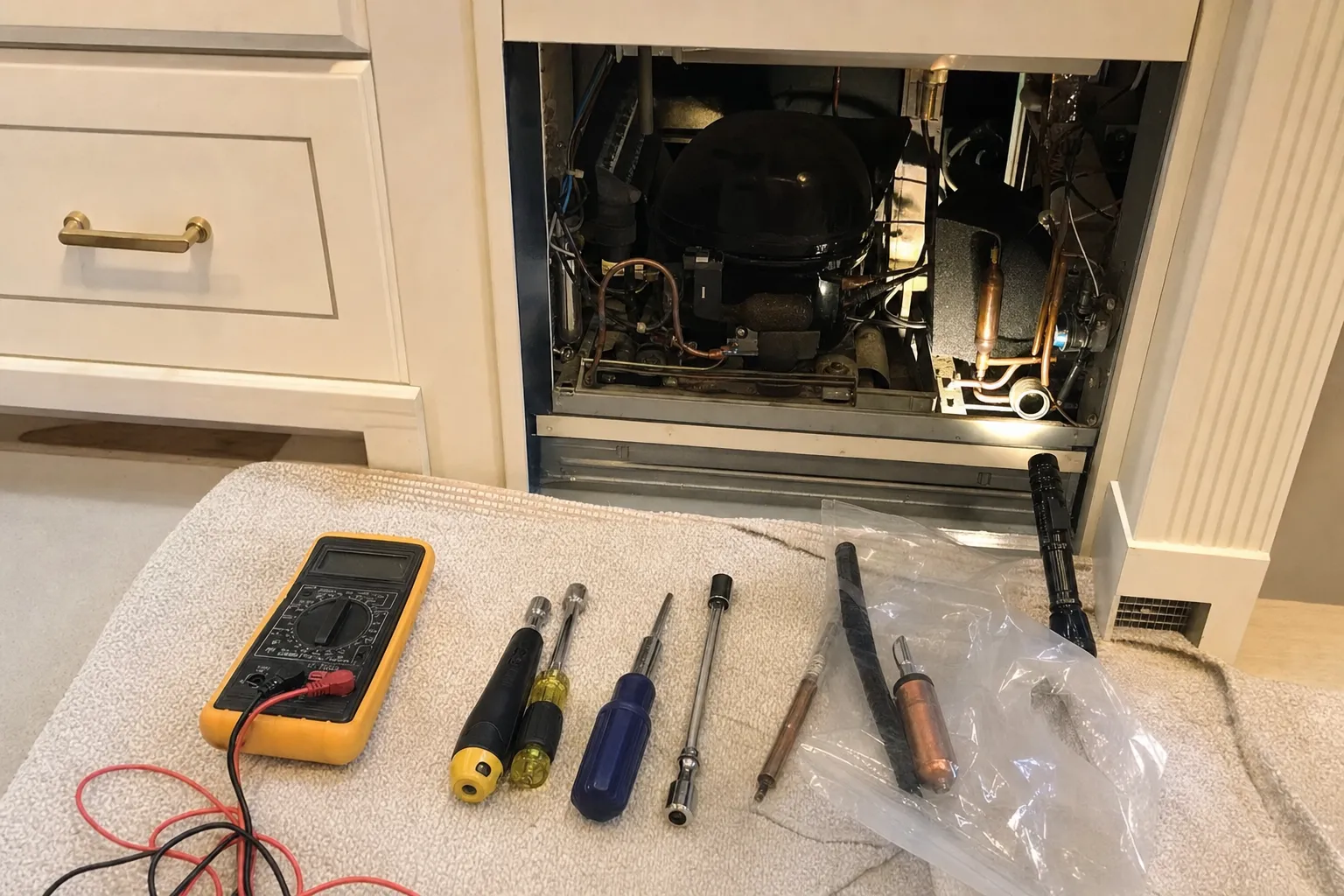
A beverage center can go wrong in two opposite directions, and some owners see both in the same week. On Mercer Island it is usually built into a bar or a lake-facing family room where the door opens all evening and the cabinetry left little air around it, which pushes a marginal unit toward warm; frozen cans tend to have a simpler cause.
Know which unit you have
Sub-Zero’s current Designer beverage centers have one temperature zone behind a full-view, UV-resistant glass door, and an upright beverage shelf with gates that lift to hold bottles and cans in place. The older UC-24BG is also a beverage center with a glass door, as the letters in its model number indicate, and it carries wine racks and a switch for its accent light inside the top of the cabinet. Either way there is one set point for the whole cabinet, so a problem shows as the whole cabinet running warm or as one area running colder than the rest. The model is on the rating plate inside the cabinet.
When everything is too warm
Treat a warm beverage center the way you would any undercounter refrigerator. Power first: a lit display, the set point you expect, nothing flashing. Then the kickplate, because the condenser sits behind it, and a bar is about the dustiest place a unit can live, among cardboard cases, paper napkins and foot traffic. Sub-Zero wants the coil cleaned every six to twelve months on the Designer line and every three to six on the older UC-24 models, with the power off first.
Then the door. A glass door shows you when the seal is failing, as fog on the inside of the glass or wet shelves. Sub-Zero points out that condensation inside a glass-door model is normal after the door has stood open, and that it clears once the door stays shut; condensation that lingers points to a gasket or a door that is not closing. Fog on the room side of the glass is a different story, told in the Lake Air notes.
Then the load. How much is inside, how warm it went in and how often the door is opened all decide how long a compressor has to run. A full restock of room-temperature cans an hour before guests arrive will not be cold by the time they do. That is physics rather than a fault.
When the cans at the back freeze
Frozen or split cans at the back while the front row is merely cool is a pattern to investigate rather than a known fault of any model, and the causes run from simple to less simple.
The set point. Check it before anything else. On the Designer controls it moves one degree at a time; if it was lowered for an occasion, bring it back up and give the cabinet a day to settle.
The packing. Air is at its coldest close to where it has just been cooled, and in a small cabinet it has little room to mix before it meets the nearest cans. Cans pressed hard against the back wall sit in that air and also block it from reaching the front. Sub-Zero makes a related point in its moisture advice: a cabinet stuffed too full stops the airflow the unit depends on. Leave a finger’s width behind the back row.
The sensor. If the setting is sensible, the cans have room and the back row still freezes, the control may be acting on a false reading. A sensor that reports the cabinet warmer than it really is keeps the unit cooling past the point where it should stop. That is a test for a meter, not a guess, and the zone thermistor page explains how these sensors drift and how they are checked.
What we check
We probe the cabinet in several places and compare the readings with the display, look at the condenser and the fan behind it, and watch how the door meets its gasket. If the readings point at the control, the sensor and its wiring are tested before the board is. The work is booked as refrigerator repair and priced after the diagnosis.
Before you call
-
Step 1
Read the set point
Compare the number on the panel with what you remember choosing. Set points get turned down for a party and left there.
-
Step 2
Probe the front and the back
Leave one thermometer in a glass of water at the front of a shelf and another at the back overnight. The gap between them tells us more than either reading.
-
Step 3
Ease the back row forward
Pull the cans off the back wall and let the shelf gates, not the wall, hold them upright. Wipe up any leaked drink.
-
Step 4
Clear the grille at the floor
Move cases, bags or a mat away from the kickplate. Bar floors are where cartons end up.
-
Step 5
Close the door and watch the glass
Check it pulls flush. Fog inside the glass that clears soon after a long opening is normal; fog that stays is not.
Past these checks the fault is inside the machine. Call Mercer Island Sub-Zero Service on (206) 208-3377 and say which step changed nothing.
Asked about this
Why did a can split inside the beverage center?
Its contents froze and expanded. That usually means the back row has been sitting in the coldest air in the cabinet, or the set point has been moved down, rather than a failed part. Clean up with a mild solution of soap, water and baking soda, which Sub-Zero recommends for interior surfaces, avoiding vinegar and alcohol-based cleaners, then check the setting.
Can a beverage center keep beer and wine at different temperatures?
Not in any controlled way. Sub-Zero's Designer beverage centers have a single temperature zone, so one set point governs the whole cabinet. Small differences between shelves exist, but they are not settings and will not stay put. If you want wine held apart from everything else, a wine unit with its own zones is the appliance built for that.
Frozen cans at the back and warm ones at the front: one fault or two?
Often one. A cabinet packed hard against the back wall can freeze its rear row and starve the front of cold air at the same time, so both symptoms come from the load. If it still happens with the cans loosely spaced, a sensor or airflow fault becomes the likelier answer. Mercer Island Sub-Zero Service can check it on (206) 208-3377.